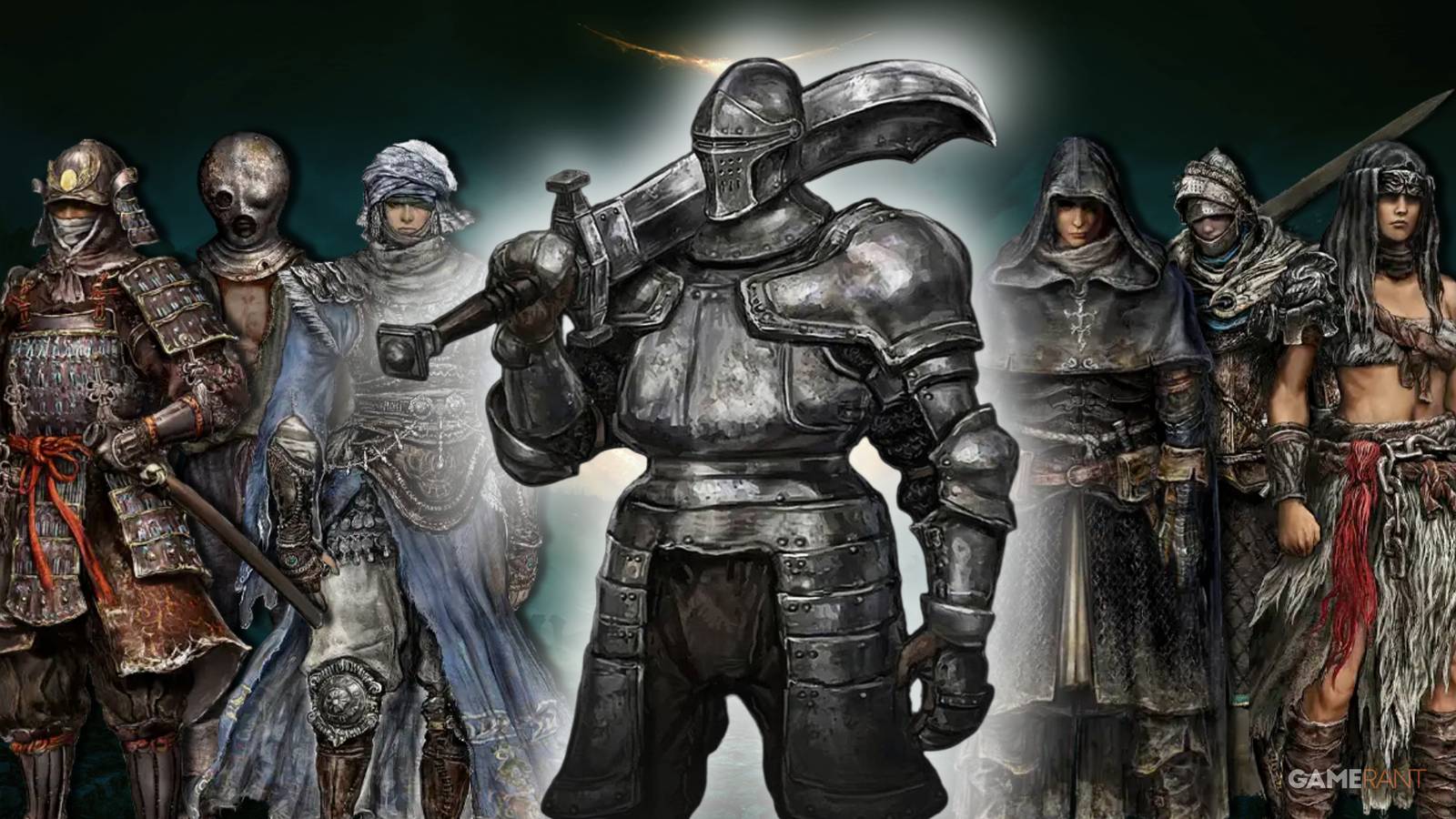
On August 28, Elden Ring is making the leap to Nintendo Switch 2 via the Tarnished Editiona packaged version of the base game, Shadow of the Erdtree, and a lean suite of new content — but fans on other platforms need not worry: the paid Tarnished Pack will make all new content available on all other platforms that same day. And though the content update is actually adding two new starting classes, one of them in particular seems like it's got a lot to say about the state of the Soulsborne community. Indeed, the new Heavy Knight, officially described as “a knight in bulky steel armor capable of mowing through foes” with an enormous new scimitar, looks like the most pointed new addition to Elden Ring by far.
It's no secret to fans of the Soulsborne games that the most vocal players in the community treat a specific style of play, consisting of light rolls, no summons, and no ranged ability, as the de facto baseline. It's been that way for years, but because of that, heavy armor builds, with their focus on poise and complete indifference to dodge rolls, have always occupied an uncomfortable middle ground somewhere between tolerated and quietly regarded. Now, with the upcoming Elden Ring update, the Heavy Knight will show up as the champion of that contested ground: a starting class with the highest Endurance stat in the game, making the unhurried statement that brute force was never the lesser path.

4 Elden Ring Dragons That Make House Of The Dragon's Beasts Look Weak
House of the Dragon's Vhagar and Caraxes are incredibly intimidating, as long as they are not standing alongside Elden Ring's dragons.
The Unofficial Fromsoft Game Rulebook
For context, this unofficial Soulsborne The playbook didn't emerge from any development-side statement—it was assembled communally, argument by argument, across forums and comment sections over more than a decade of online discourse. The core of it runs something like this:
-
No Spirit Ashes or cooperative summons
-
No Mimic Tear
-
No cheese
From that angle, the correct way to experience a FromSoftware boss is to “git gud,” stand in front of it alone, learn every phase, and earn the kill through raw repetition. It's totally reasonable logic in isolation, but as with any kind of overarching fandom “law,” it has a way of expanding until it covers builds, leveling decisions, and what constitutes an “honest” kill a bit overzealously.

Put the consoles in the correct order.
Start
Put the consoles in the correct order.
Easy (5)Medium (7)Hard (10)
And as a result, heavy armor builds have sat uncomfortably in that framework for a long time. Staying under fifty percent equip load became a soft community standard—a signal of proper engagement with the dodge-and-punish rhythm that defines FromSoftware's combat mechanics at their most celebrated, and a way of demonstrating you'd internalized what the game was “really” asking of you. Anything above that threshold earned the name “fat rolling,” a term that kind of contains its verdict in its name, and players who opted for full plate over agility were routinely characterized as unwilling to learn the franchise's gameplay language.
Of course, at its worst, this kind of thoughtless condescension extends in every direction. Elden Ring's magic users were told they were bypassing the series' complex combat, shield users were called passive and unengaged, and anyone who used the co-op system to handle a brutal boss encounter had their victory dismissed as something less than earned. There's an elaborate, spanning system for invalidating wins of all colors; heavy armor builds just occupy one of the more permanent slots—not rule-breaking enough to be controversial, but passively judged by the players who read staying fast as staying honest.
The funny thing is that FromSoftware has never really encoded these strictures into the games themselves—Havel the Rock drops his armor in the original Dark Souls for a reason. Poise mechanics have been the subject of dedicated balance passes, and Colossal weapons received entire patch cycles of attention reflecting the player base that actually uses them. The developers have literally shipped over a decade's worth of content that treats heavy, aggressive, slow-rolling combat as a fully realized design priority—and then watched as a portion of its community built an unofficial standard and defended it with the confidence of people backed by some divine-law text that was never actually written.
Elden Ring Tank Builds Get Their Starting Class
Now, the Heavy Knight arrives at character creation with the highest starting Endurance among Elden Ring's other starting classes, a formidable Vigor count, and a new curved greatsword that makes an immediately interesting case for itself. Previously, a solid Curved Greatsword this early in a run required beating Bloodhound Knight Darriwil, but the Heavy Knight sidesteps that gating entirely. It isn't much of a head-start, it's meaningful for a class that carries no shield — just armor, a weapon, and an expectation of forward motion, at least, according to the Heavy Knight's official description:
A knight in bulky steel armor capable of mowing through foes with a substantively-sized scimitar.
That specificity is key here, too, as the operative phrase of the description for Elden Ring's Heavy Knight, “mowing through foes,” implies that blunt, forward aggression is the main course, rather than a consolation for players who can't master evasion. From the jump, the class presents itself as the perfect fit for players who “never cared about the roll-and-punish meta and are just doing fine without, thanks.” It makes its own argument, and as funny as that is, it's also pretty great.
The Idus Knight and Its Subtler Dex-Faith Focus
Ultimately, though, the Heavy Knight isn't the only new class coming to Elden Ring Tarnished Edition. Alongside new armor, weapons, and customization options for Torrent, the Idus Knight—a lighter, more dexterity-focused option with faster weapons and flexible armor—rounds out the class list in a rather deliberate way. It seems that as Elden Ring makes its way onto the Switch, FromSoftware is filling out two gaps in the build spectrum at once.
Naturally, these classes' stat distributions inform their role, too. The Heavy Knight is optimized specifically for melee— Mind, Intelligence, and Faith are all left extremely low — and that optimization creates a meaningful shortcut: players can reach the Vigor and Strength thresholds for mid and late-game heavy armor builds in Elden Ring significantly earlier than with any existing class. The Idus Knight, meanwhile, has a distinctly higher faith than the other dex-centric classes, though it comes at the cost of being closer to a jack of all trades type as well.
Note: Heavy Knight also arrives with the highest starting poise in the roster, meaning the stance-breaking aggression that heavy builds typically unlock mid-game is available as an Elden Ring run's opening premise instead.
At the end of the day, Elden Ring Tarnished Edition positions these two new classes as meaningful updates to a roster that did have some room to grow. Considering what few details fans know about the breadth of the new content this early on, The Heavy Knight remains the key detail. But as fans on the Nintendo Switch 2 gain a great game, and existing players across all platforms are offered the (still mysteriously priced) Tarnished Packthe takeaway should be simple: if you paid for Elden Ringplay it however you want; beyond getting slammed back to a Site of Grace by Melania, Radhan, or a sleeper-pick like Godfrey, literally nobody can stop you.


- Released
-
August 28, 2026
- ESRB
-
Mature 17+ / Blood and Gore, Language, Suggestive Themes, Violence