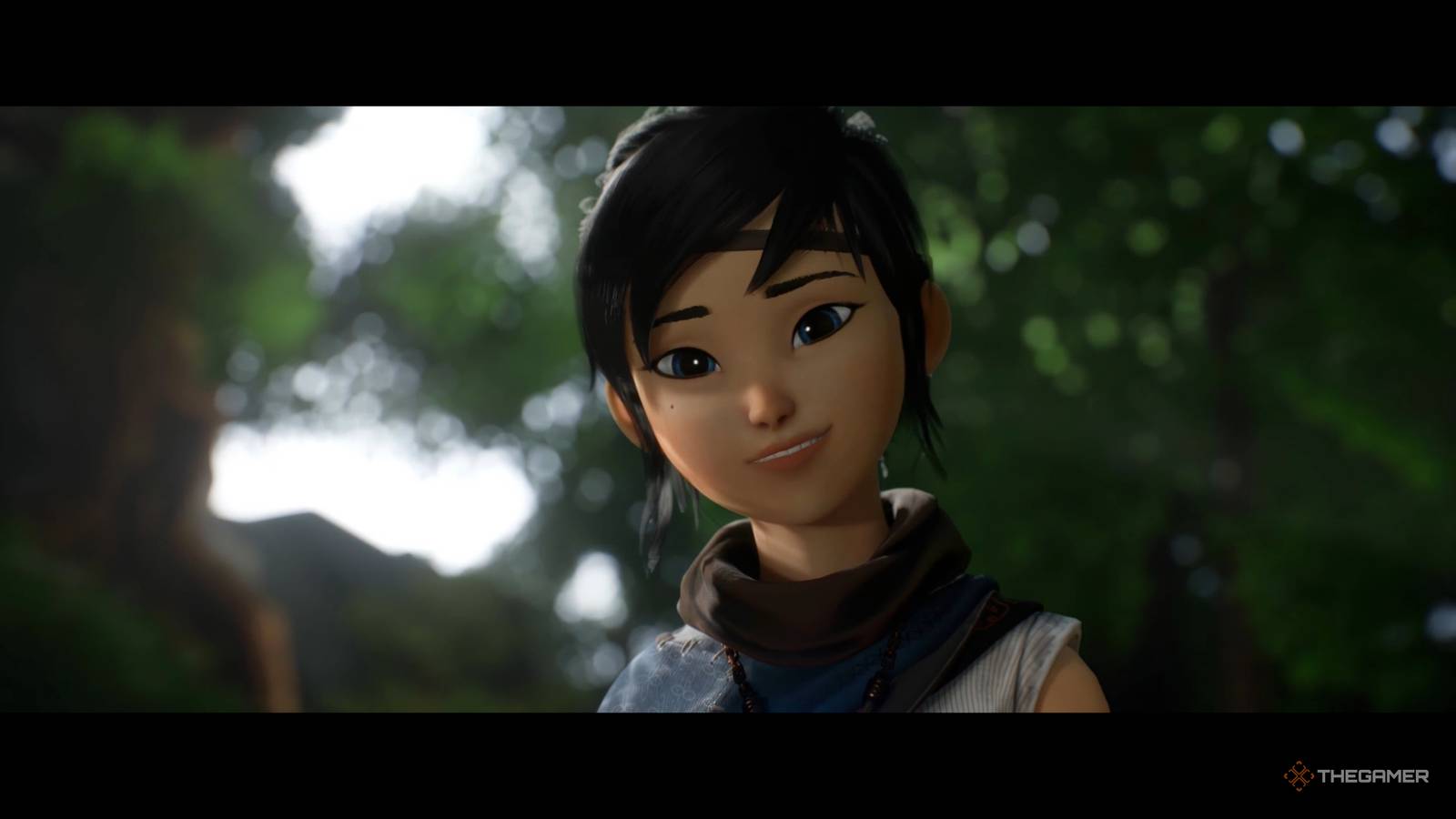
Kena: When Bridge Of Spirits first released for PlayStation consoles in 2021, I wasn't particularly interested. But I was fascinated by its gorgeous art style, and was glad to see Sony supporting a single-player project rather than yet another triple-A journey of third-person surrealism. And now, five years later, thanks to the recently released Switch 2 port, I'm finally getting to participate in this adventure myself.
Let's get the obvious facts out of the way first. This is a fairly decent Switch 2 port that runs at a fixed and relatively stable 30 frames per second, with the exception of a few noticeable drops in the village hub area. Docked play definitely offers greater visual clarity, but it looks basically the same no matter how you play it. No matter how you look at it, it's a visually striking experience, which is convenient considering it's the one aspect of the game that feels undeniably unique.

Kena is, in many ways, a game about the middle. Thematically, it's about being caught between life and death. As a port, it acts as a bridge between the PS4 and PS5 versions. Chronologically, it is halfway between the original game and its sequel. And overall, it's a pretty middling experience.
This is not a statement made out of cynicism. Kena was designed with heart, and we believe every decision made here was one that developer Ember Lab believed would make the game better. And as the studio's first full-fledged project, it's incredibly impressive. But it still feels more like a game than functions like one.
Ember Lab's roots are as an animation studio, and they've produced a number of big commercials, but what really made them famous was Terrible Fate, the Zelda fan film based on Majora's Mask. Creating a game in itself was the logical next step. The love for the mask carried over from that fan film as an homage to its roots and as a central icon of the game.

The problem is that games require a different design language than movies (animated or otherwise). For decades, games have chased movies as an advanced medium that can emulate rather than understand their own unique qualities. Meanwhile, Kenna is an extremely rare example of a movie that wants to be a game.
But just as games often drop mechanical depth in the pursuit of a cinematic experience, Kena doesn't really understand what the game is about. There's platforming, cutscenes, and combat, but none of it feels unique to this game or does anything new. I look at the Rot, small forest spirits you collect throughout the story that power up your attacks and perform small puzzle tasks, and wonder why they feel like Disney-esque animal companions suited to the film's comedic relief rather than creatures with mechanical depth like Pikmin or The Wonderful 101.
To be clear, the gameplay is perfectly fine. In fact, there is nothing inherently bad about Kena. This is a small area where a general lack of gaming awareness shows up. In combat, parry is provided. However, it feels like every single attack uses different timing to activate its parry. Dodge doesn't seem to have an I-frame. There is no canceling animation. All inputs feel slow. When riding a platform, if you don't land on the platform perfectly, you'll just slide down. No matter what actions you take in the air, Kena will not be able to grab the ledge.

Kena as a whole feels like a pastiche of games, a collage of Frankenstein's gameplay limbs from other successful experiences because it believes it should look and act a certain way. Several pieces that make up a whole. But like Frankenstein's monster, Kenna lacks the cohesion that makes it natural. These are all problems in themselves, but some of them may be due to lack of experience or lack of research. But what I partly feel is a lack of vision.
Ember Lab has spoken about Kena's inspiration in the past. Kratos is referred to as a loose mechanical blueprint for the protagonist, and while Kena can hold her own, it shouldn't feel like a power fantasy. It's a reasonable inference, but it stems from a flawed foundation that raises bigger questions. Why is combat the primary means of exploring these stories and themes? Why rely so heavily on platforming? Sometimes it feels like a game where you observe others rather than actually playing. For movies, that's the be all and end all. Watch, rewatch, and analyze. But games are understood through interaction, and that distinction is important.
These structural problems persist throughout the overall story. It's a true, simple, emotionally grounded story about what people will go to to protect the ones they love. However, when a game's narrative structure becomes too formulaic, its simplicity begins to fail. There are three main areas for you to venture into. To explore you need to get 3 masks. Collect the three relics and defeat the boss of the area. Do this three times and the game is over. Suspension of disbelief is impossible when the structure is too repetitive. Instead of using mechanical structure to strengthen the narrative, it actually weakens it.

One thing that Kena focuses on is, of course, animation. The Japanese and Indonesian inspiration behind the art direction and music is well-researched and, although somewhat disconnected from the story it tells, while moving it seems like a dream come true. Watching the reveal trailer for the upcoming sequel, Scars of Kosmora, it's encouraging to see it move away from some of the over-the-top DreamWorks and Disney-inspired features and further refine the style that makes it feel so unique.
Combat feels instantly more responsive, and your soulmate's actions feel more tied to the world in a tangible way. Only time will tell if the full game will ever be completed, but hopefully we can improve on what already works and take the time to introduce mechanics that will yield great results. It's not just a movie dressed up in game costumes.

Kenna: Bridge of Souls
- released
-
September 21, 2021
- ESRB
-
T for Teens: Fantasy Violence
- developer
-
Ember Lab
- publisher
-
Amber Research Institute
